Key Takeaways
- Sports massage for runners can help manage muscle tightness and movement restrictions that may make running feel less comfortable or efficient.
- Treatment is most useful when guided by assessment rather than focused solely on the area that feels tight or sore.
- Repeated calf, hip, knee or hamstring tightness may be linked to mobility limitations, training load or movement patterns that also need attention.
- Hands-on treatment works best alongside appropriate exercise, sensible training progression and enough time between harder sessions.
Introduction
Most runners think about improving performance by adding mileage, adjusting pace or building fitness. But how your body is moving between those sessions matters too. You may still be able to complete your runs with tight calves, stiff hips, or limited ankle mobility, but those restrictions can make your stride feel less natural and harder to maintain as fatigue builds.
This is where sports massage for runners can fit into a training routine. It will not make you faster on its own, but it can help manage muscle tension, maintain mobility, and support recovery so you can keep training more comfortably and consistently.
At Sports Massage Clinic, we do not assume the tightest area is the only problem. Our ATE™ Method combines Assessment, Treatment and Exercise. We first look at how you move and where restrictions or imbalances may be affecting you, then use appropriate hands-on treatment and corrective exercises based on our findings.
How Sports Massage Supports Running Performance
Improving Mobility for More Efficient Running
You can be fit enough to handle the distance and still feel restricted when you run. We often see this when mileage increases, speed work is added, or recovery between sessions becomes shorter. The issue may show up as tight calves, stiff hips or a sense that one side is not moving as freely as the other.
For example, a runner may come to us because one calf consistently tightens during longer runs. On assessment, however, we may find that ankle movement on that side is limited. If the ankle cannot move through its usual range of motion comfortably, the body may compensate elsewhere, placing more demand on the knee, hip, or opposite leg.
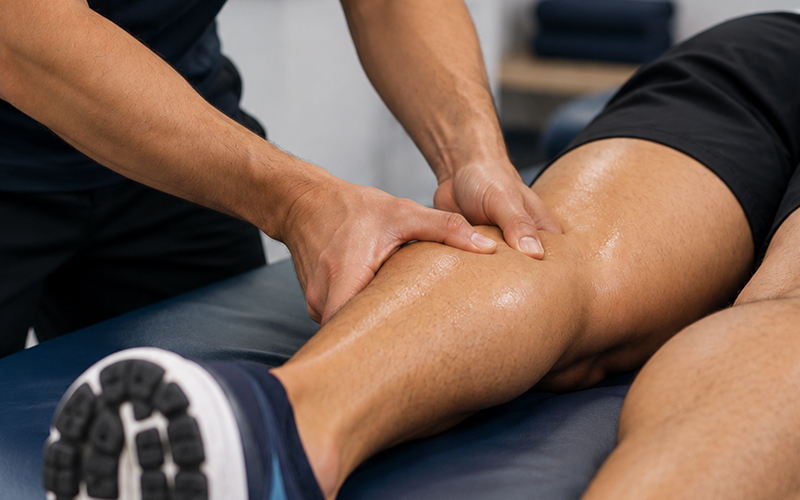
In this situation, simply working on the calf may only address part of the problem. We may use massage to reduce muscle tension, while also checking ankle mobility and leg control. This is where sports massage therapy differs from a general relaxation massage: the treatment is guided by how the restriction is affecting your movement when you run.
Better mobility will not automatically make you faster, but it can help your stride feel less restricted and easier to maintain as training demands increase.
Supporting Recovery Between Training Sessions
Training rarely happens in isolation. You might finish an interval session, head out for an easy run the next day, then return to another harder workout while your quads, calves or hamstrings still feel heavy. Nothing may be injured, but accumulated fatigue can still affect how freely and comfortably you move.
This is where sports massage for runners can support running recovery between demanding sessions. We may use treatment to help reduce muscle tightness and soreness, but the approach should match where you are in your training cycle. During a high-mileage week, for example, lighter work may be more appropriate, while more focused treatment may fit better when there is more time before your next key session.
Deep tissue massage can be useful in some cases, but more pressure does not always yield better results. We adjust the intensity based on your training load, how your tissues respond, and what you need from the session, rather than treating every runner the same way.
Helping Address Factors Linked With Overuse Problems
As mileage builds, small movement restrictions or changes in control become more noticeable because the same tissues are loaded thousands of times over the course of a run.
Take a runner who keeps feeling tightness around the outside of the knee. Working only on the sore area may provide temporary relief, but we would usually look beyond it. That can include the hips, hamstrings, TFL, and IT band region, as well as how well the leg controls load during movement. Our RunFit Therapy also considers common problem areas around the knee, hip, calf, shin and ankle rather than treating each area in isolation.
We take the same approach with recurring Achilles discomfort. A sudden increase in training, repeated loading, and tight calf muscles can all contribute, so assessment may include how you walk, move and load the lower leg.
Sports massage for runners cannot guarantee prevention of an overuse injury. What it can do is help us identify persistent tightness, restricted movement, or compensation patterns early, and then decide whether hands-on treatment, exercise, or changes to training load may be more appropriate.
How Running Places Stress on the Body
Running places repeated demands on the same muscles, tendons and joints with every stride. Your calves and Achilles help manage load around the ankle, the quads and hamstrings work around the knee, while the hips and glutes help control the pelvis and leg as you move.
As mileage, pace or training frequency increases, these tissues need enough time to recover and adapt. If sports recovery is not keeping up with the training load, you may start to notice stiffness, reduced movement or subtle changes in your running biomechanics.
Pain is not always the first sign. One leg may start to feel less smooth than the other, your stride may shorten as you tire, or the same muscle may repeatedly tighten after faster sessions. These smaller changes can be useful clues that your body is not recovering as well as it normally does.
Why Running Performance Depends on More Than Massage Alone
Massage can help you move more comfortably, but the changes you make afterwards are just as important.
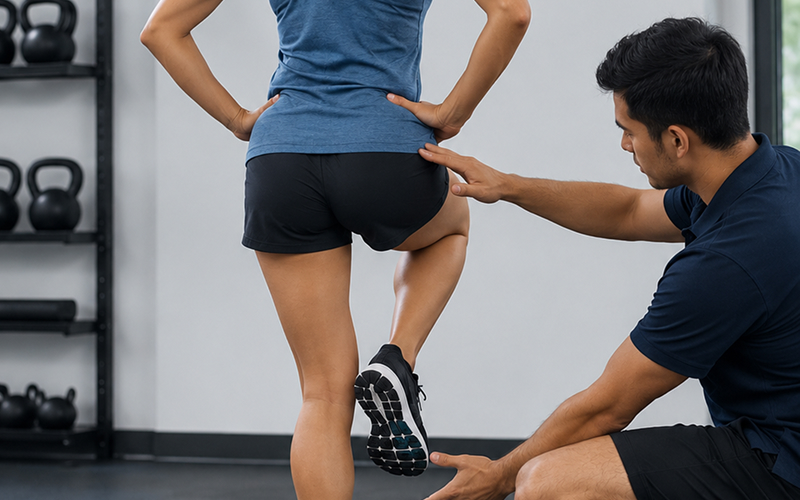
Based on what we find during assessment, we may recommend mobility, strength or control exercises alongside treatment. If your ankle movement is restricted, for example, we may focus on calf and ankle mobility. If you keep shifting load towards one side, hip strength or single-leg control may need more attention. The aim is to address the movement pattern behind the recurring tightness rather than repeatedly working on the same area.
This is why sports injury massage should not be used without considering the wider picture. If your symptoms suggest that hands-on treatment is not appropriate, we may recommend delaying massage and seeking medical assessment instead. Our recovery partners are trained to recognise when treatment is suitable and when a referral is the safer next step.
When Should Runners Consider Sports Massage?
Sports massage can be useful at different points in a training cycle, especially when your usual recovery starts to feel less reliable. That might be during a higher-mileage block, in the lead-up to a race or when the same areas keep tightening after runs.
For example, during marathon training, a runner may still be completing sessions but notice that one calf, hip or hamstring is becoming increasingly restricted as the weeks progress. In that situation, treatment can help manage the buildup of tension while we also assess whether mobility, strength, or training load needs attention. After a demanding race block, the focus may be different, with treatment aimed at helping the body settle before harder training resumes.
It is also worth considering an assessment if your stride starts to feel different, one side repeatedly feels tighter than the other, or recovery is taking longer than usual. Those changes do not always mean you are injured, but they can be useful signs that your body is struggling to keep up with the current training load.
Conclusion
Sports massage for runners is most useful when it supports the foundations of better running: consistent training, enough recovery, good mobility, appropriate strength and efficient movement.
At Sports Massage Clinic, we start by assessing how you move rather than assuming the tightest muscle is the whole problem. Treatment can help reduce restrictions, while corrective exercises address the movement issues that may be contributing to them.
The goal is not to promise faster running from massage alone, but to help you move and recover well enough to train consistently. If recurring tightness, restricted movement or slower recovery is beginning to affect your runs, book a session with Sports Massage Clinic. We can assess what may be limiting you and recommend a treatment and exercise plan that fits your training.