
Key Takeaways
- The clearest difference in DOMS vs muscle strain is often when the discomfort starts and how it behaves during movement.
- Generalised stiffness that appears after training and eases as the body warms up is more consistent with normal post-exercise soreness.
- Sharp, localised pain, swelling, bruising or noticeable weakness may indicate an injury rather than routine training soreness.
- Looking at symptom onset, pain location, movement limitations and changes in strength can help determine whether simple recovery or further assessment is more appropriate.
Introduction
Feeling sore after a hard workout is nothing unusual. Maybe you tried a new exercise, lifted heavier than usual or pushed the pace on a run, and the next day your muscles are stiff and tender. Most of the time, that is simply part of how the body responds to a new training load. But sometimes the soreness feels different enough to make you wonder whether you have actually injured something.
That distinction matters. Normal post-workout soreness may be uncomfortable for a few days, but continuing to load an injured muscle can make recovery more difficult.
When we compare DOMS vs muscle strain, we do not judge it by pain intensity alone. We look at when the discomfort started, whether it is widespread or localised, which movements aggravate it and whether strength or normal movement has changed. These details help us tell the difference between normal training soreness and a possible muscle injury.
Understanding DOMS and Muscle Strain
Delayed onset muscle soreness, or DOMS, usually develops after a workout that is harder or less familiar than what your body is used to. It is particularly common after movements that load a muscle as it lengthens, such as lowering into a squat, running downhill or controlling the lowering phase of a lift.
This type of soreness is part of the body’s response to increased training load. Feeling stiff or tender afterwards does not automatically mean that the muscle has been injured.
A muscle strain is different. It happens when muscle fibres are overstretched or damaged, often during a sudden or forceful movement. Sprinting, accelerating, changing direction quickly or lifting under a load the muscle cannot tolerate can all lead to a strain.
The difference often becomes clearer when we look at how the symptoms started. Someone returning to split squats after a long break may wake up the next morning with both thighs feeling stiff and sore. That pattern is more in keeping with DOMS. By contrast, someone who feels a sharp pull in one hamstring while accelerating and immediately changes their stride gives us more reason to suspect a strain.
DOMS vs Muscle Strain: How to Recognise the Difference
When Did the Pain Begin?
Timing is one of the first things we look at because DOMS and a muscle strain often begin quite differently.
DOMS usually develops after the workout, not during it. Soreness may start to become noticeable around 12 to 24 hours later and can feel strongest over the next one to three days.
A muscle strain is more likely to cause pain during the movement that caused the injury or shortly afterwards. Someone may be able to point to the exact sprint, lift or change of direction when they first felt something pull or hurt.
There are exceptions, especially with milder strains, but when the pain started gives us an important clue about what may be going on.
Does It Feel Widespread or Very Specific?
DOMS tends to affect a broader area of the worked muscle. After a demanding leg session, for example, both quadriceps may feel generally stiff or tender when sitting down, climbing stairs or getting out of bed.
Muscle strain symptoms are often more localised. One spot may feel painful, with the discomfort becoming sharper when the muscle is stretched or asked to contract.
Where you feel the pain also matters. Not every ache near a muscle is coming from the muscle itself. If discomfort is concentrated around the knee rather than through the quadriceps, for example, we would also look at the joint and surrounding tissues instead of assuming it is training soreness. This same assessment-led approach applies when someone comes to us for knee pain massage, where we consider how surrounding muscles, the joint, and movement patterns may contribute to the discomfort.
What Happens Once You Start Moving?
DOMS often feels worse during those first few movements after rest. Once you start walking around or warming up gently, the muscle may begin to loosen, and movement can feel more comfortable, even if some soreness remains.
A strain may respond differently. Stretching, contracting or loading the injured muscle can reproduce the pain, and you may find yourself changing how you move to avoid it.
For example, someone who trained shoulders the night before may wake up with general tenderness across both deltoids. That is quite different from sharp pain in one shoulder that makes reaching overhead difficult. When pain is centred around the shoulder joint or starts limiting normal movement, it may need a more focused assessment rather than being treated as routine soreness. In these cases, shoulder pain treatment may involve looking more closely at the joint, surrounding muscles and the movements that reproduce the pain.
Are There Visible Signs or Noticeable Weakness?
DOMS can leave a muscle feeling tender, stiff, and temporarily harder to use, but obvious bruising or substantial swelling is unusual.
With a more significant strain, swelling, bruising, muscle spasms or weakness may be present. A calf strain, for example, may make it difficult to push off normally when walking or running, rather than simply making the calf feel sore after exercise.
A noticeable loss of strength, significant or worsening swelling or bruising, or difficulty using the affected area normally is a reason to have the problem assessed rather than treating it as ordinary training soreness. Severe pain, numbness or tingling also warrants more prompt medical attention.
Why Accurate Assessment Supports Better Recovery
Feeling sore does not always tell you what is actually causing the problem. That is why, when distinguishing between DOMS and muscle strain, we look at more than the level of discomfort alone.
During an assessment, we ask what type of training you were doing, whether you noticed anything unusual during the session and how the symptoms have changed since. We also check which movements reproduce the discomfort and how the area responds under load.
In some cases, the pattern is consistent with normal soreness after unfamiliar or demanding exercise. In others, localised pain, weakness or difficulty with certain movements may suggest a soft tissue injury that needs a more cautious return to activity or further medical assessment.
It is also important to confirm where the symptoms are actually coming from. Pain when gripping after a gym session, for example, may involve structures around the wrist or forearm rather than general soreness in the arm muscles. In cases like this, the assessment may point towards a more specific approach such as wrist pain treatment.
If the findings suggest an injury that is not appropriate for sports massage, we recommend further assessment or referral rather than trying to treat the area through massage alone.
Supporting Muscle Recovery Without Guessing
Good muscle recovery is not about trying to get rid of every ache as quickly as possible. It is about giving the body enough time to recover while gradually reintroducing the level of load it can handle.
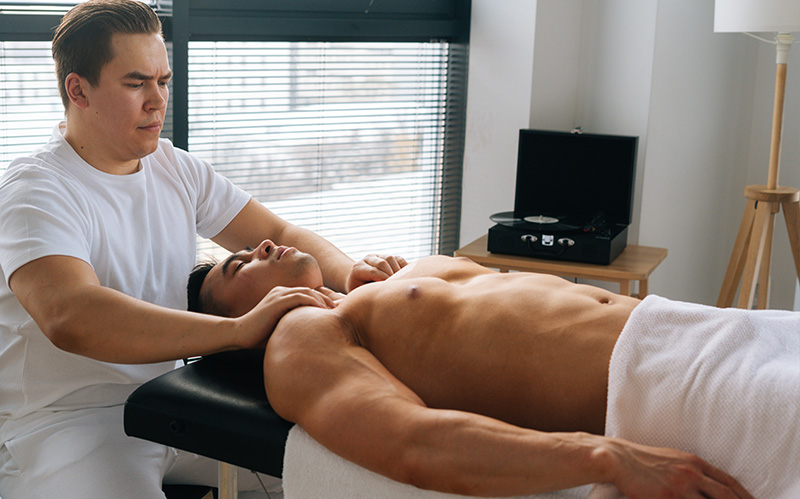
For ordinary DOMS, gentle movement, adequate sleep, sensible training progression and enough recovery between harder sessions may be all that is needed. Sports therapy massage may also help ease muscular tightness and make movement feel more comfortable after training.
If a strain is suspected, recovery needs to be handled differently. Working aggressively into a recently injured muscle can irritate the area further, so we first assess what the tissue can tolerate. From there, we can introduce hands-on treatment, mobility work, and progressive exercise at a pace that matches the stage of recovery.
We also look at what may have contributed to the problem in the first place. A sudden increase in running distance, fatigue during repeated sprints or losing control under a heavier load can all increase stress on the muscles. Addressing those factors helps make the return to training more gradual and reduces the chance of falling back into the same pattern.
Know What Your Soreness Is Telling You
The key question is not simply whether a muscle hurts after exercise. What matters is when the pain started, where you feel it, how it behaves when you move and whether your usual strength or movement has changed.
When comparing between DOMS and muscle strain, DOMS is more likely to develop gradually after training and ease as the body recovers. A muscle strain is more likely to involve a specific painful area, a clear moment when something felt wrong, and difficulty loading the muscle as you normally would.
At Sports Massage Clinic, we use our Assessment, Treatment and Exercise approach to understand what may be causing your symptoms before deciding whether hands-on treatment is suitable. If your soreness feels unusual, keeps getting worse or starts affecting how you move, book an assessment with us so we can identify the next appropriate step and help you return to activity safely.